
prevention
AI Cart Abandonment Prevention Popups vs. Exit-Intent Popups: What's Actually Different
Exit-intent popups react to one signal and show the same offer to everyone. See how AI cart abandonment prevention actually differs, and why it converts better.
 ChatGPT
 Perplexity
 Gemini
 Claude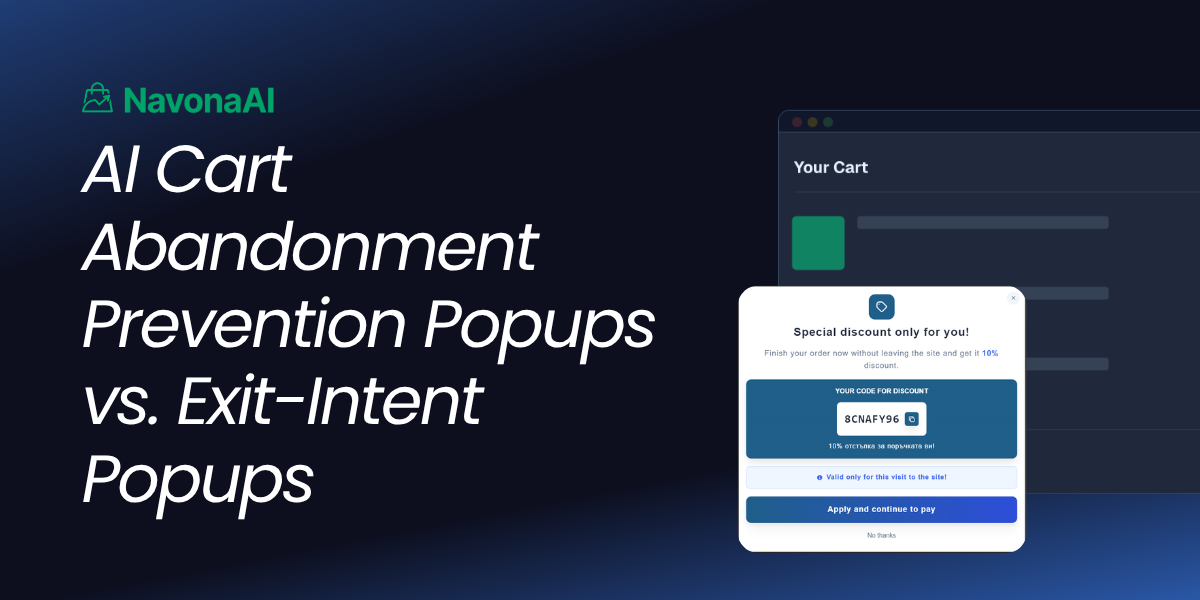
Most articles about exit-intent popups describe the same tool: a script that watches your cursor, notices you're heading for the close button, and throws a discount at you on the way out. That description is accurate, and it's also the reason most exit-intent popups underperform. They're built to catch an exit. They're not built to prevent one.
This is the distinction that matters: an exit-intent popup detects that a visitor is leaving. An AI cart abandonment prevention system predicts whether a visitor with items in their cart is actually going to leave, then shows them a personalized discount that applies instantly to their cart. The offer expires the moment they leave, so the scarcity is real. No friction, no email required, and you stay in control of the rules, including a minimum cart value if you want one.
Same trigger moment, different amount of thinking behind it.
What is an exit-intent popup?
An exit-intent popup is an overlay that appears when a visitor shows behavioral signals of leaving a page.
On desktop, a script tracks cursor movement. When the cursor accelerates toward the top of the browser window, heading for the close button, the back arrow, or the address bar, the popup fires.
On mobile, there's no cursor to track, so detection relies on a mix of signals instead: rapid upward scrolling, a tap on the back button, switching tabs, or a pause in activity.
That's how nearly every exit-intent tool on the market works. What has changed is what happens after the trigger fires, and that's where the split between "exit-intent" and "AI prevention" actually starts.
Where standard exit-intent popups fall short
Three patterns show up across almost every exit-intent implementation, and each one quietly limits how well it converts.
1. They ask for something before they give anything. The majority of exit-intent popups exist to collect an email address, a phone number, or at minimum an answer to a question, before giving the shopper anything back. That's a reasonable trade for list-building, but it's friction, and friction at the exact moment someone is already out the door is a strange place to add a form field.
2. The "urgency" is a headline, not a mechanism. "Ending soon." "Won't appear again." "Only for this visit." These lines show up constantly in exit-intent copy, and the more often a returning visitor sees the same urgency message reused on every session, the less it means. Real urgency builds trust. Fake urgency wears it down, even if shoppers don't notice the first time.
Better copy alone doesn't fix this. What fixes it is making the claim true: the offer is generated once for that shopper, and if they don't act on it, the code is deactivated shortly after and won't be reissued to them again on that same device. The popup actually stops repeating itself, instead of just claiming it won't.
3. One signal decides everything. Nearly every exit-intent system makes a single decision: is this cursor, scroll, or tap pattern an exit signal, yes or no? If yes, show the popup. That's it. There's no second check on whether this specific shopper is likely to respond to an offer at all, or whether showing one is even worth the discount.
Not every abandoning shopper needs a discount to convert. Some just need a moment, and would have completed the purchase anyway. Giving them 15% off costs you margin for nothing.
What "AI prevention" actually changes
This is where NavonaAI's approach differs from a standard exit-intent tool.
Two-layer prediction system. Our system makes two key predictions for every shopper. First, an abandonment prediction: is this shopper likely to leave without completing checkout? This looks at how they're browsing, how they're moving the mouse, scrolling, and behaving on the page, on top of the same exit-intent signals every tool uses. Second, an intervention prediction: if we show this shopper an offer, will they complete their purchase? Not every abandoning shopper should see a popup. Our system predicts whether an intervention will actually lead to a conversion, avoiding unnecessary discounts.
No email, no phone number, no form. The popup only appears to shoppers who already have items in their cart. There's no lead-capture step first, no email field, no quiz, no questions. The discount applies directly to the cart and carries straight through to checkout. One click, done.
Genuine urgency and scarcity. The discount is valid only for this website visit and expires the moment the shopper leaves. This isn't fake urgency, the offer genuinely disappears if they go. Each customer sees the popup exactly once per device. If they don't accept the offer on the spot, the discount is deactivated and they won't see the popup again on that device, not on their next visit, not ever. There are no second chances or follow-up reminders. This isn't manufactured scarcity, the opportunity genuinely disappears.
It gets smarter the longer it runs. During the first 30 days after installation, the system relies more heavily on proven heuristic signals (exit intent detection, time-on-page patterns, scroll depth). After that, it starts learning your store's own visitor patterns, and the predictions get more accurate for your actual customers, instead of relying on a generic model trained on someone else's traffic. The longer NavonaAI runs on your store, the smarter it gets at predicting both who will abandon and who will respond to an offer.
A/B testing. You can run direct experiments, testing one discount amount against another, or testing prevention on versus off, to see the exact impact on your store.
You can see exactly what it's recovering. The dashboard shows how much revenue you're losing to abandonment and how much the NavonaAI prevention popup is bringing back, with a simple view for the essentials and a deeper view if you want to dig into the numbers. It's not a black box you have to trust blindly. You can watch it work.
NavonaAI (prevention) vs. recovery vs. capture
Most content in this space lumps popups, discount triggers, and abandoned-cart emails into one bucket: "getting the sale back." But they're not the same thing, and that confusion is why a lot of stores end up running three tools that all try to do the same job, instead of three tools that each cover a different part of it.
| AI Cart Abandonment Prevention | Email/SMS Marketing | Generic Exit-Intent Popups | |
|---|---|---|---|
| Shows while a shopper is still on the site | Yes | No | Yes |
| Only triggers when cart has items | Yes | No | No |
| Requires an email or phone number | No | Yes | Yes |
| Uses AI to predict abandonment before it happens | Yes | No | No |
| Discount stops working shortly after they leave unused | Yes | No | No |
| Best use case | Prevent the abandonment | Recover it after the fact | Lead capture |
Prevention stops the abandonment before it happens, at the moment the shopper is still on the page. Recovery (email/SMS) reaches shoppers after they've already left, hoping to bring them back later. Capture is a broader category, covering most generic exit-intent tools, aimed at getting something (an email address, a subscription) out of a visitor who was leaving anyway, whether or not there's a cart involved at all.
A store's most effective setup usually uses all three for what they're actually good at: prevention to stop the loss in the moment, recovery to catch what prevention missed, and capture for visitors who weren't close to buying yet but are worth staying in touch with.